
There are more solutions than obstacles. Nicolas Zart
How loud are flying cars and air taxis? How often do we hear this question from the public.
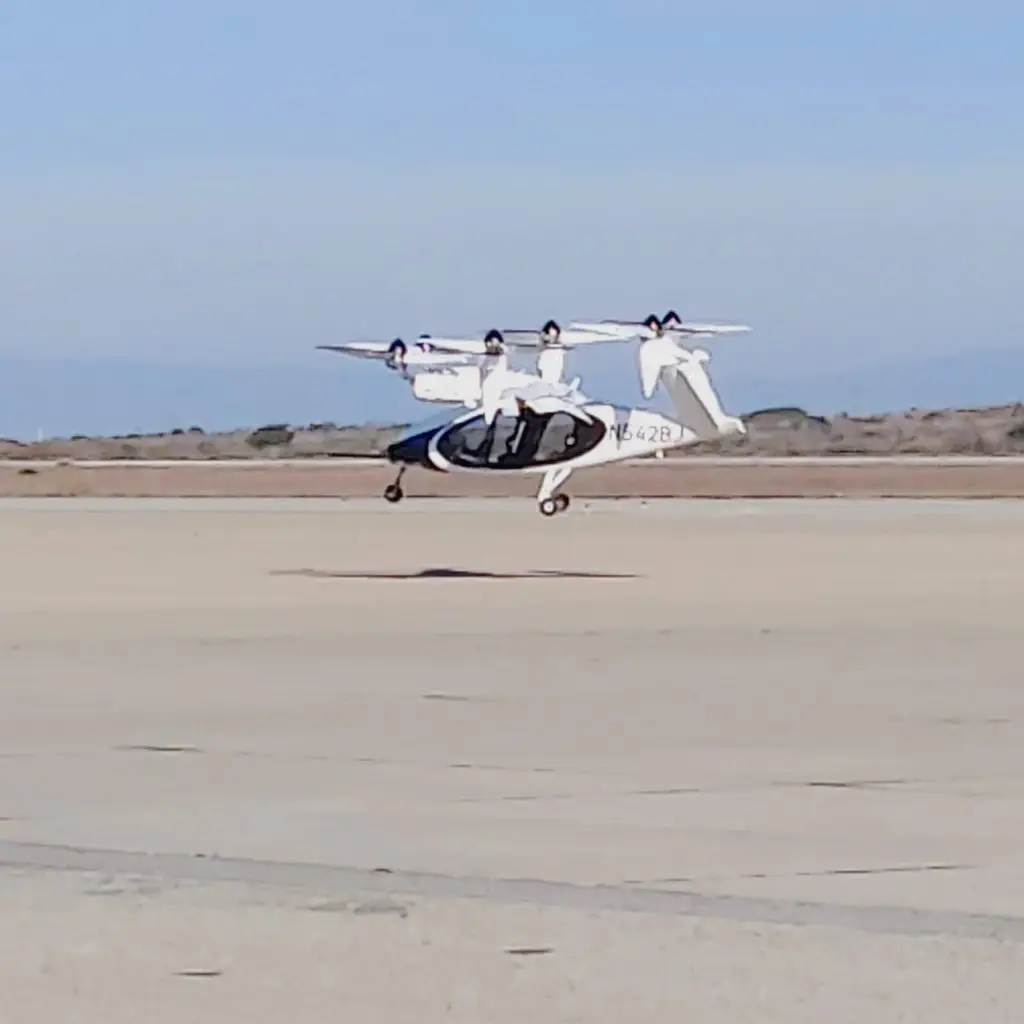
My first experience watching an “air taxi” take off was at Marina Municipal Airport, where Joby Aviation’s S-4 lifted off just 300 feet in front of us. The whirl and whizz wasn’t unpleasant at all—it was different and unexpected. You could hear it tapering off for the first 100 feet to near silence by 300 feet. After that, only the fixed-wing chaser was audible.
Then, at flight’s end, a massive Coast Guard Leonardo helicopter roared in for landing practice. Needless to say, it drowned out everything else.
This moment—Joby eVTOL, fixed-wing chaser, and heavy helicopter all in the sky simultaneously—was etched in my mind as a career highlight in innovative mobility.
I’ve since witnessed Archer‘s original Maker prototype, Wisk‘s 6th generation, and Pivotal’s remarkable Helia (the subject of today’s NASA acoustic study) among many more. So just how quiet are eVTOLs on average?
NASA’s (PDF) recent acoustic testing of Pivotal’s BlackFly eVTOL marks a pivotal moment for advanced air mobility (AAM). Using a sophisticated 24‑microphone ground array, NASA measured BlackFly’s flyover noise footprint and directivity patterns, offering the industry its first independent, publicly available dataset for a single‑seat electric vertical takeoff aircraft.
This NASA–Pivotal acoustic study isn’t just another manufacturer test—it’s a critical step toward standardized noise benchmarks that will shape vertiport siting, community acceptance, and FAA certification pathways. For AAM engineers, investors, and policymakers, the results are promising.
Pivotal BlackFly: The Test Subject
Pivotal’s BlackFly is a single‑seat, piloted eVTOL with fixed wings and a ducted fan pusher configuration. Unlike multicopters or tiltrotors, BlackFly’s design prioritizes simplicity and low cost, making it a potential “Model T” for personal air mobility.
The NASA tests focused on full‑tilt operations—BlackFly’s signature transition from hover to forward flight. This phase is acoustically challenging for eVTOLs, as rotor loading changes dramatically. NASA’s campaign captured data across multiple flight profiles, providing a comprehensive noise signature.
Listen to our latest The Ways We Move podcast with Pivotal’s CEO Ken Karklin and Quality Control lead Matt Hubbard where we discuss BlackFly’s design philosophy and future plans.
NASA’s Testing Methodology: Rigorous and Replicable
NASA deployed a 24‑microphone linear array on the ground to map BlackFly’s noise directivity. Key parameters included:
- Flyover altitudes: 300–1,000 ft AGL
- Flight profiles: Hover, climb, cruise, descent, full‑tilt transition
- Metrics captured: Sound pressure levels (dB(A)), spectral content, directivity patterns
This mirrors methodologies used for Joby Aviation’s tests in 2022 and sets a template for future eVTOL acoustic validation.
Pivotal shared select data visualizations showing BlackFly’s noise envelope, with flyover levels in the 60–75 dBA range at typical vertiport setbacks—comparable to a conversation or quiet propeller aircraft.

Key Findings: Quiet Enough for Urban Vertiports?
The NASA–Pivotal acoustic study highlights BlackFly’s strengths:
1. Exceptionally Low Hover Noise
BlackFly’s ducted pusher configuration produces a narrower noise footprint than open multicopters, with minimal sideline radiation. This is critical for vertiports near residences.
2. Smooth Tilt Transition
Full‑tilt operations showed no significant “whoosh” or impulse noise spikes, a common eVTOL challenge. Spectral analysis revealed broadband rotor noise rather than tonal harmonics.
3. Cruise Efficiency
At forward flight speeds, BlackFly’s fixed‑wing design yields the lowest overall levels, approaching small GA aircraft.
Quantitative snapshot (approximate from Pivotal’s charts):
| Flight Phase | Noise at 500 ft (dBA) | Equivalent To |
|---|---|---|
| Hover | 65–70 | Normal conversation |
| Tilt Transition | 68–72 | City traffic at distance |
| Cruise | 60–65 | Quiet suburb |
Compared to NASA’s Joby data (70–85 dBA in hover), BlackFly demonstrates the potential for personal eVTOLs to meet community noise goals.
Implications for AAM Stakeholders
Engineers and OEMs
- Validates ducted pusher as a low‑noise architecture for single‑seat class.
- Provides baseline for computational aeroacoustics modeling.
Regulators (FAA, EASA)
- Supports Part 36 Stage 5 noise certification feasibility.
- Informs vertiport noise contours for zoning.
Investors and Operators
- Demonstrates Pivotal’s path to commercialization with minimal acoustic retrofit risk.
- BlackFly’s quiet profile enables residential vertiport adjacency.
Communities and Policymakers
- At 65 dBA hover, BlackFly is quieter than Amazon delivery drones or leaf blowers.
- Enables “air taxi lite” operations in suburbs, not just airports.

Context from Pivotal Leadership
In our exclusive interview, Pivotal CEO Ken Karklin emphasized noise as a “make or break” for personal AAM: “We designed BlackFly to be neighbor‑friendly from day one.” Quality lead Matt Hubbard added that NASA’s independent validation accelerates their FAA Part 103 ultralight path to market.
What’s Next for eVTOL Acoustics?
Pivotal plans to release the full NASA dataset publicly, enabling third‑party analysis. This transparency sets a new standard for AAM manufacturers.
Future tests should include:
- Human response studies (annoyance metrics).
- Multi‑vehicle operations (vertiport swarm noise).
- Tiltrotor/multicopter comparisons.
The NASA–Pivotal acoustic study proves eVTOL noise isn’t an insurmountable barrier—it’s a solvable engineering challenge. With BlackFly’s data now public, the AAM industry gains a concrete benchmark for what’s possible.
ElectricAirMobility.news covers the engineering, policy, and business of advanced air mobility. Subscribe for weekly insights. Check out our Patreon site for early access, deep-dives and business intelligence.
And for previous episodes of the Ways We Move on your favorite podcast platforms, see:
▶️ Watch on YouTube: https://www.youtube.com/@TheWaysWeMove📺
🔊 Apple Podcasts: https://podcasts.apple.com/ca/podcast/the-ways-we-move/id1797599255 🔊
🎧 Listen on Spotify: https://open.spotify.com/show/4V0qe3eZqublwn6dasXWCf 🎧
🎙️ Amazon Podcasts: https://music.amazon.com/podcasts/cd3349e1-275f-4691-ae38-f1b6a153d5e5/the-ways-we-move 🎙️
📻 iHeart Radio: https://www.iheart.com/podcast/269-the-ways-we-move-268614085/ 📻
🌱 Buzzsprout: https://thewayswemove.buzzsprout.com/ 🗣️
🎬 Patreon education and news analysis! https://www.patreon.com/c/TheWaysWeMove 🔒
📢 Support now: https://www.patreon.com/c/TheWaysWeMove
Subscribe for more insights into the future of mobility and support the show! https://www.buzzsprout.com/2428454/supporters/new 📡
Related Reading