
There are more solutions than obstacles. Nicolas Zart
Now that January 2026 is over, let’s look at what happened in this pivotal months filled with developments shaping the future of Advanced Air Mobility (AAM). From historic regulatory restructuring in the United States to China’s aggressive commercialization push and record-breaking investments in autonomous delivery, this comprehensive roundup will give you the month’s most significant AAM news.
FAA’s Historic Reorganization Creates Dedicated Office for Advanced Aviation
In the largest organizational overhaul in its history, the Federal Aviation Administration announced a comprehensive restructuring on January 27 that elevates advanced air mobility to top-level priority within the agency.

Transportation Secretary Sean P. Duffy and FAA Administrator Bryan Bedford unveiled the sweeping changes, which include creating a dedicated Office of Advanced Aviation Technologies specifically to oversee integration of drones, eVTOLs, and supersonic aircraft into U.S. airspace.
Why This Matters
The reorganization addresses a fundamental challenge the AAM industry has faced: navigating responsibilities scattered across multiple FAA divisions. The new structure consolidates these under a single office with clear leadership and budgetary visibility within the agency’s Flight Plan 2026 strategy.
“It’s important that we have the right people in the right places to do the best work possible,” Administrator Bedford stated. “These actions will put permanent leaders in place who embrace innovation, share safety data and insights freely, and are focused on deploying a brand-new air traffic control system all while integrating key innovation technologies into the new National Airspace System.”
Key Structural Changes
The reorganization creates nine major organizational units:
1. Office of Advanced Aviation Technologies
The designated point for all activities related to integrating advanced aviation technologies including Advanced Air Mobility, Unmanned Aircraft Systems, and supersonic aircraft. This office receives top-level status alongside traditional aviation operations, signaling that eVTOLs and drones are no longer experimental edge cases but core components of America’s aviation future.
2. Aviation Safety Management System (SMS) Organization
Perhaps the most transformative change for AAM safety oversight, this new organization implements a single safety management system and risk management strategy for the entire FAA, replacing different safety metrics previously siloed in individual offices.
For advanced air mobility, this centralization means safety data from drone operations will now inform eVTOL safety assessments and vice versa. The FAA can analyze safety patterns across all advanced aviation technologies, identify systemic risks earlier, and apply lessons learned more broadly.
3. Airspace Modernization Office
Required by the FAA Reauthorization Act of 2024, this office takes responsibility for modernizing the National Airspace System, including planning, research and development, systems engineering, and portfolio management.
The current air traffic control system, built on decades-old technology, cannot efficiently manage the density and complexity of urban air mobility operations. Modernization priorities affecting AAM include digital communication systems to replace voice-based ATC, automated traffic management for low-altitude operations, integration of unmanned traffic management (UTM) with traditional ATC, and vertiport-to-ATC communication protocols.
4. Policy and Legal Office
Consolidating rulemaking and regulatory activities, this office oversees strategic policy, stakeholder engagement, and financial assistance. For AAM operators awaiting final regulations on powered-lift operations, vertiport standards, and autonomous flight, this centralization may speed development and reduce conflicts between different regulatory teams.
5-9. Additional Offices
The reorganization also includes Administration and Finance, Air Traffic Organization, Aviation Safety Oversight and Certification, Commercial Space Transportation, and Security and Intelligence organizations.
Industry Impact
The timing is critical. With multiple eVTOL manufacturers approaching certification in 2026-2027, the eVTOL Integration Pilot Program launching this year, and the 2028 LA Olympics showcasing urban air mobility, the FAA needed organizational capacity to manage not just certification but the operational integration that follows.
Secretary Duffy emphasized that “funding is only one piece of the puzzle,” referring to the unprecedented $12.5 billion down payment to modernize airspace. “With these critical organizational changes, the FAA can streamline the bureaucracy, encourage innovation, and deliver a new air traffic control system at the speed of Trump—all while enhancing safety.”
Importantly, the restructuring will not result in reductions in force but instead shifts more key leadership posts to permanent positions and consolidates IT, finance, and human resources under the Administrator.
Ohio Emerges as America’s AAM Manufacturing Hub
While regulatory structure evolves, Ohio is proving that AAM manufacturing at scale requires more than vision—it requires coordinated workforce development, strategic infrastructure, and sustained investment.
Joby’s Second Ohio Facility
eVTOL leader Joby Aviation’s announcement of acquiring a second manufacturing facility in Dayton—a more than 700,000-square-foot complex—underscores Ohio’s growing reputation as one of the fastest-moving AAM ecosystems in the country.

The facility will initially support Joby’s plan to produce four aircraft per month by 2027, with significant room for future growth. Operations are expected to begin in 2026, complementing Joby’s existing manufacturing footprint in California and its first Ohio facility announced in 2023.
The JobsOhio Advantage
Unlike traditional state economic development agencies, JobsOhio operates as a private nonprofit with an unconventional funding model: it reinvests approximately $450 million annually from Ohio’s liquor distribution profits directly into economic development initiatives.
“That independence allows us to move quickly and plan long term,” explained J.P. Nauseef, President and CEO of JobsOhio. “Every deal is customized, but every deal also has to produce a return for Ohio.”
That return is measured primarily through job creation and payroll tax generation. Across more than 4,000 deals completed by JobsOhio, the average break-even period for new businesses is under two years.
Workforce as Infrastructure

If there’s a single factor driving Ohio’s faster pace in AAM, it’s workforce investment. Nearly every JobsOhio deal includes a workforce component—customized training programs, partnerships with community colleges and universities, or relocation incentives designed to attract specialized talent.
Ohio graduates more than 100,000 STEM students annually, supported by a dense network of universities, technical colleges, and job centers. To further strengthen the talent pipeline, JobsOhio recently launched a relocation incentive program that reimburses up to $15,000 per person—and up to $250,000 per company—for workers relocating to Ohio in 71 critical disciplines.
“For advanced aerospace manufacturing, the workforce is the difference between ambition and execution,” Nauseef noted. “Companies need people who can work reliably, at scale, in a regulated environment, and they need them now.”
A Living Laboratory
Ohio offers unmatched proximity across the AAM ecosystem between customers, researchers, test facilities, and manufacturers.
At the heart sits Wright-Patterson Air Force Base, home to the Air Force Research Laboratory and the National Air and Space Intelligence Center. Complementing it is the National Advanced Air Mobility Center of Excellence (NAMC) in Springfield, offering a uniquely permissive testing environment created through early FAA engagement.
Established more than a decade ago, NAMC allows drone and eVTOL manufacturers to test aircraft without seeking individual FAA waivers, dramatically reducing development friction. Last August, BETA Technologies completed a flight demonstration with its ALIA CTOL aircraft at The Ohio State University’s airport.
“For manufacturers, it’s the only place in the country where you can identify the requirement, develop the technology, test it, and then manufacture it at scale, all within close proximity and at an affordable cost,” Nauseef explained.
Joby Aviation, like many AAM companies operating in Ohio, leverages both the Springfield test corridor and ongoing collaboration with the Air Force Research Laboratory while planning to employ up to 2,000 people near Dayton for production alone.
China’s Low-Altitude Economy: From Aspiration to Reality
While the United States reorganizes and scales infrastructure, China continues demonstrating what happens when regulatory agility meets industrial policy and capital deployment.
The Numbers Tell the Story

China’s Ministry of Industry and Information Technology released comprehensive figures on January 3-4, 2026, quantifying what had been largely aspirational: 1,081 registered enterprises building aircraft, 3,623 product types certified, and 5.29 million units in active service as of December 30, 2025.
These aren’t counts of prototypes or regulatory registrations. These are operating aircraft.
The low-altitude economy maintained annual growth exceeding 10% throughout China’s 14th Five-Year Plan (2021-2025). Market valuations reached 670 billion yuan in 2024, with projections targeting 1.5 trillion yuan by year-end 2025 and 3.5 trillion yuan ($498 billion) by 2035.
Certification Speed Advantage
China’s certification velocity continues outpacing Western timelines significantly. EHang achieved CAAC type certification for its EH216-S in 31 months using 40,000 test flights—becoming the world’s first certified eVTOL aircraft in October 2023. AutoFlight’s CarryAll cargo eVTOL received certification in 2024.
Compare this to FAA and EASA timelines stretching 5-7 years or longer. Joby Aviation, leading the U.S. pack, began power-on testing of its first conforming aircraft for Type Inspection Authorization in November 2025, entering the final stage of FAA Type Certification. Industry analysts project the first U.S. eVTOL certification unlikely before 2027, with some estimates ranging to 2028-2030.
CAAC’s faster certification reflects a different regulatory philosophy: China certifies simpler aircraft first, allowing operational experience to mature the ecosystem before tackling complex mobility applications.

Commercial Operations Today
While passenger eVTOL operations in Western markets remain largely theoretical, China’s approach has generated actual commercial activity:
EHang secured one of the first air operator certificates for civil human-carrying pilotless aerial vehicles from CAAC. The certification enables consumers to purchase flight tickets for low-altitude tourism and urban sightseeing in Guangzhou and Hefei. In June, EHang received a purchase order for 50 units of its EH216-S from Guizhou Scenic Tourism Development Co. for deployment in scenic areas.
The company reported adjusted net income of 9.4 million yuan in Q2 2025 on revenues of 147.2 million yuan—while modest, this positive adjusted figure distinguishes it from Western competitors still burning cash without commercial revenue streams.
AutoFlight’s CarryAll completed significant operational milestones, including a cross-sea flight from Shenzhen to Zhuhai covering 50 km in 20 minutes—the world’s first public inter-city eVTOL demonstration over water. The two-ton cargo aircraft can carry 400 kilograms for up to 200 kilometers and holds all three certifications required for commercial operations: Type Certificate, Production Certificate, and Airworthiness Certificate.
Manufacturing Scale: EHang has broken ground on facilities targeting 1,000 units per year at its Yunfu site, with additional factories in Hefei and Weihai. XPeng AeroHT is building a flying car factory targeting mass production by 2026, with the Land Aircraft Carrier integrating a ground vehicle with a detachable eVTOL module capable of a 30-kilometer range.
Infrastructure Deployment
China’s infrastructure development matches its manufacturing ambition:
- Shenzhen committed to building more than 1,200 takeoff and landing sites by 2026, backed by 12 billion yuan ($1.7 billion) over two years. By mid-2024, Shenzhen had completed 249 facilities with 147 more scheduled by year-end.
- Guangzhou plans to build 100 vertiports by 2027, revealing 12 application scenarios covering sea, land, and air operations with drones, eVTOL aircraft, and uncrewed vehicles.
- Nearly three-quarters of Shenzhen’s airspace below 120 meters is open for commercial flights.
The 15th Five-Year Plan Priority
China’s 15th Five-Year Plan (2026-2030) identifies the low-altitude economy as a strategic emerging industrial cluster, elevating it to national priority alongside quantum technology and AI. This isn’t aspirational positioning—it’s coordinated multi-year capital deployment across government levels with unified industrial policy.
Global Expansion Challenges
Chinese eVTOL manufacturers seeking international certification face fragmented standards, extended timelines, and scrutiny that exceeds technical requirements. FAA and EASA certification cycles potentially exceed three years even under bilateral airworthiness agreements. Export restrictions on dual-use technologies further limit addressable markets.
However, manufacturing cost advantages provide competitive positioning in price-sensitive markets. DJI’s dominance of 70% of the global commercial drone market demonstrates that Chinese manufacturers can achieve global leadership in contested industries.
Zipline Soars with $600M Funding Round
While eVTOL companies chase certification and commercialization, one drone delivery company is already scaling profitably: Zipline announced on January 21 that it surpassed 2 million commercial deliveries and raised more than $600 million in new funding, valuing the company at $7.6 billion.
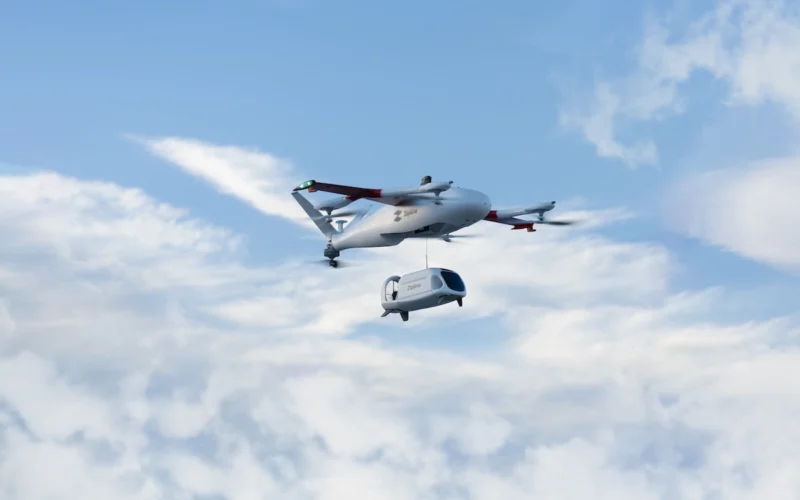
Explosive U.S. Growth
The funding round, which included participation from Fidelity Management & Research Company, Baillie Gifford, Valor Equity Partners, and Tiger Global, will fuel Zipline’s expansion to at least four U.S. states in 2026.
The company will launch operations in Houston and Phoenix in early 2026, with customers able to order tens of thousands of items through the Zipline app with deliveries arriving in as little as 10 minutes.
Zipline’s U.S. deliveries have grown approximately 15% week-over-week for the last seven months, making it one of the fastest-growing AI and robotics companies in the world.
A Proven Model
Founded in 2014, Zipline developed its own drone delivery ecosystem, including logistics software, launch and landing systems, and the aircraft themselves. The company got its commercial start in 2016 using autonomous drones to deliver blood in Rwanda.
Today, Zipline operates on four continents, makes a delivery somewhere in the world every 30 seconds, and serves more than 5,000 hospitals and health facilities. To date, Zipline’s zero-emission aircraft have flown more than 125 million autonomous commercial miles, delivering more than 20 million items without a serious injury.
For context: driving 120 million miles in the U.S. would typically result in nearly 600 crashes, about 100 injuries, and at least one fatality, according to NHTSA data.
Two-Platform Strategy
Zipline operates distinct drone platforms tailored to different delivery needs:
Platform 1: Fixed-wing aircraft designed for long-range flight (up to 120-mile round trips), providing commercial items via parachute delivery. This platform supports enterprise and government logistics.
Platform 2: Designed for ultra-fast urban delivery, capable of delivering items weighing more than 5 pounds in as little as 10 minutes directly to customers’ homes.
CEO Sees 2026 as Breakout Year
“Autonomous logistics has been maturing for more than a decade, and the last year has made it unmistakably clear that when deliveries are faster, cleaner, safer, and cheaper, demand isn’t just high, it grows exponentially,” said Keller Cliffton, CEO and co-founder of Zipline. “In 2026 autonomous logistics will become an everyday staple for people across several states in the U.S.”
Competitive Landscape
Zipline faces competition from Amazon Prime Air, Alphabet’s Wing (which recently announced plans to expand its Walmart partnership to 150 stores by 2027), DroneUp, and Flytrex. However, Zipline’s track record and scale differentiate it—the company currently completes a delivery every 30 seconds somewhere in the world.
“In the next 5-10 years, deliveries made by autonomous aircraft will become standard,” said Antonio Gracias, founder, CEO, and chief investment officer of Valor Equity Partners. “That revolution is going to be led by Zipline. There’s no better team, company, and product positioned to lead the charge.”
Converging Toward the Tipping Point
January 2026’s developments reveal an industry approaching critical inflection points on multiple fronts:
Regulatory Maturation
The FAA’s reorganization demonstrates regulatory recognition that AAM and UAS integration isn’t coming—it’s here. Creating dedicated top-level offices for advanced aviation technologies, centralizing safety management, and prioritizing airspace modernization provides the organizational foundation AAM needs to scale.
Geographic Competition
The contrast between U.S. and Chinese approaches couldn’t be starker. While the United States deliberates certification timelines and builds organizational capacity, China deploys commercial eVTOL operations, builds vertiport infrastructure at scale, and integrates low-altitude economy into national industrial policy.
Ohio’s success demonstrates that U.S. states can compete through coordinated workforce development, testing infrastructure, and strategic incentives. But individual state efforts, however successful, face structural challenges when competing against unified national strategy backed by centralized capital deployment.
Business Model Validation
Zipline’s $7.6 billion valuation and operational profitability validate that autonomous aerial delivery can work commercially when properly executed. The company’s 15% week-over-week growth demonstrates market demand for faster, cleaner, safer delivery.
For eVTOL air taxi services still pursuing certification, Zipline’s trajectory offers both encouragement and caution: encouragement that autonomous aerial operations can scale profitably; caution that achieving profitability requires solving complex operational, economic, and regulatory challenges simultaneously.
Infrastructure Investment
From Ohio’s coordinated ecosystem development to China’s billion-dollar commitments to vertiport construction, January’s news underscored that AAM requires substantial infrastructure investment. Charging systems, vertiports, maintenance facilities, air traffic management integration—all demand capital and coordination before commercial operations can scale.
The FAA’s $12.5 billion airspace modernization down payment represents one piece of this infrastructure puzzle. But as Ohio demonstrates, workforce development, testing facilities, and manufacturing capacity constitute equally critical infrastructure requiring strategic investment.
Looking Ahead
As February begins, several trends bear watching:
FAA Leadership Appointments: Who leads the new Office of Advanced Aviation Technologies will significantly shape AAM’s trajectory in the United States. Industry will watch whether appointments signal innovation enablement or cautious gatekeeping.
eIPP Selection: Which five locations win the first eVTOL Integration Pilot Program projects in 2026, and how effectively does the new FAA structure support them? Success here could accelerate AAM deployment nationwide.
China’s Export Push: As Chinese manufacturers complete domestic deployments and pursue international markets, how will Western regulators respond to certification applications? The tension between technical airworthiness standards and geopolitical considerations will intensify.
Certification Milestones: Multiple Western eVTOL manufacturers project certification progress in 2026. Whether timelines hold or slip will reveal how effectively the FAA’s reorganization accelerates processes.
Investment Sentiment: Zipline’s successful $600 million raise demonstrates investor appetite for proven autonomous aerial operations. Whether similar enthusiasm extends to eVTOL manufacturers still pursuing certification will shape capital availability throughout the sector.
January 2026 demonstrated that advanced air mobility’s trajectory depends not on any single company or technology breakthrough, but on coordinated progress across regulation, infrastructure, manufacturing, workforce development, and business model validation.
The pieces are moving into position. Whether they align to enable broad commercial deployment—or remain frustratingly close to the tipping point without quite reaching it—will define 2026’s ultimate significance for AAM’s future.
For comprehensive coverage of advanced air mobility developments, certification progress, and infrastructure news, visit [ElectricAirMobility.news]. Follow us for ongoing analysis of the AAM industry’s evolution.