
There are more solutions than obstacles. Nicolas Zart
Advanced air mobility doesn’t need airports. It needs the right aircraft.
On March 9, 2026, the U.S. Department of Transportation and the FAA announced that Electra — the Virginia-based hybrid-electric aviation company we caught up at Verticon 2026 last week — will participate at the inaugural eVTOL Integration Pilot Program. The eIPP is the most significant federal commitment to advanced air mobility deployment in U.S. history, and Electra is at the front of the line.

For an industry that has spent years waiting for the regulatory framework to catch up with the technology, the eIPP is the crucial practical first step before commercial operations. It will show the hows and whys. It will show the public what does this AAM landscape look like. And for Electra specifically, it is validation of its strategy built diligently since the company’s founding.
What Makes the EL9 Different
Electra’s EL9 Ultra Short is not an eVTOL in the conventional sense. It is a nine-passenger hybrid-electric fixed-wing aircraft that takes off and lands in just 150 feet — one-tenth the runway distance required by conventional aircraft of the same class, and a capability previously limited to helicopters and purpose-built eVTOLs.
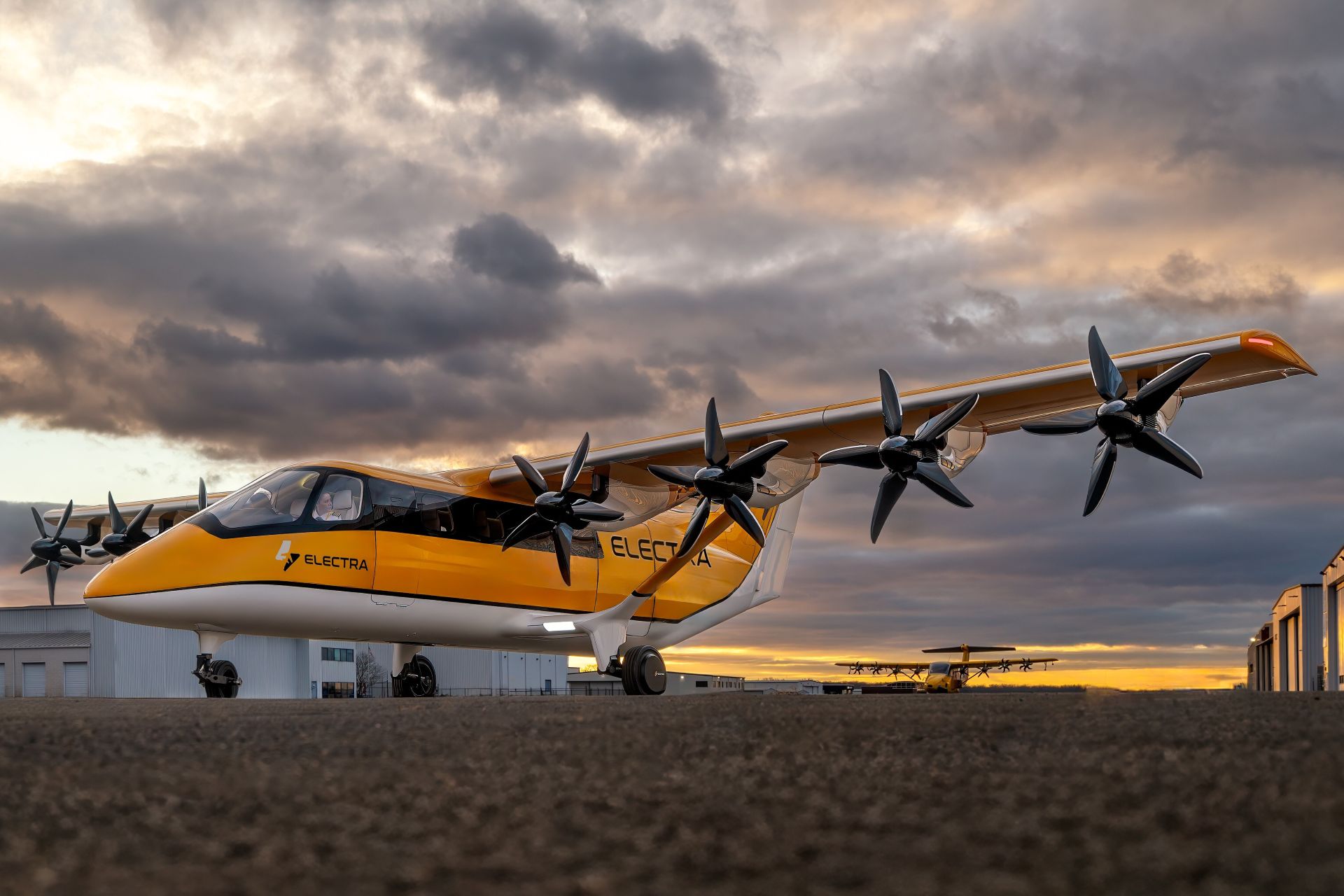
The secret is blown lift technology combined with distributed electric propulsion. Eight electric motors drive air over the wing and large flaps, generating lift coefficients greater than 20 — seven times greater than the 2.5 to 3 range typical of unblown wings. A Safran TG600 turbogenerator, derived from the company’s proven Aneto turboshaft engine, produces 600 kilowatts of power and recharges the aircraft’s four independent battery packs in flight. That in-flight recharging is critical: it eliminates dependence on ground charging infrastructure entirely, extending the EL9’s effective range to over 1,100 nautical miles.
The performance case is direct: 2.5 times the payload of a helicopter, 10 times the range, 70 percent lower operating costs, and 100 times less noise. Marc Allen, Electra’s CEO and Boeing veteran, has put it plainly: hybrid-electric propulsion enables things that jet fuel alone simply cannot do.
The eIPP: What It Is and Why It Matters
The eIPP — the Electric Vertical Takeoff and Landing and Advanced Air Mobility Integration Pilot Program — was established under the White House’s Unleashing Drone Dominance Executive Order. It creates formal public-private partnerships between the federal government, state and local authorities, and private aviation companies to develop the operational frameworks, regulations, and infrastructure that will govern commercial AAM deployment in the United States.

Electra’s participation reflects both the maturity of its technology and the breadth of its state partnerships. Demonstrations are planned across Florida, New York, New Jersey, Pennsylvania, and Louisiana, covering urban connectivity, regional access, and infrastructure integration across some of the most congested and underserved air corridors in the country.
Electra’s eIPP demonstrations will initially use its EL2 Goldfinch two-seat prototype — the aircraft that has been accumulating flight test hours since 2023 — before transitioning to the full EL9 production aircraft as it progresses through certification. The program spans three years, giving Electra a structured timeline to demonstrate real-world operations while the EL9 completes its FAA Part 23 certification pathway.
Four Demonstrations, Four Markets
Florida — In partnership with the Florida Department of Transportation and Vertiports by Atlantic, Electra will demonstrate how AAM aircraft can connect dense urban cores with regional destinations. Candidate routes across the state are already under evaluation, leveraging existing regional airline operator relationships for practical, scalable operations.
New York and New Jersey — Working with the Port Authority of New York and New Jersey, Signature Aviation, and Vertiports by Atlantic, Electra will demonstrate a New Jersey to New York City route using existing heliport infrastructure. This use case targets one of the most congested ground corridors in the world with a faster, lower-noise alternative.
Pennsylvania — In coordination with PennDOT, Electra is advancing an Ultra Short Access Point demonstration linking Atlantic City to regional destinations including feeder service into Philadelphia International Airport, using existing state test sites and medical centers to prove regional airline integration.
Louisiana — As a supporting partner to the state’s eIPP submission, Electra’s relationship with Bristow Group — the global vertical flight leader and Electra’s operational launch partner — provides the operational backbone for Gulf Coast demonstrations.
The Order Book and the Certification Timeline
Electra has accumulated more than 2,200 pre-orders for the EL9 from over 60 commercial operators worldwide, representing nearly $10 billion in market value. Customers span six continents and include Bristow Group, JetSetGo, Blade India, Flapper in Latin America, flyv in Europe, LYGG in Scandinavia, Caverton Helicopters in Nigeria, and Global Vectra Helicorp in India — among many others.
The EL9’s first prototype parts are now flowing into Electra’s final assembly facility in Manassas, Virginia. First flight is targeted for late 2027, with FAA Part 23 type certification and commercial service entry anticipated by late 2029 or early 2030. A critical design review is expected by late 2026, and a Series C funding round is planned for this year to carry the program through to certification.
Parts for the EL9 prototype are beginning to flow into final assembly in Manassas. A location for the permanent final assembly line — selected from an initial field of 140 candidate sites down to a shortlist of six — will be announced in the first half of 2026.
Direct Aviation: A New Category
Electra has coined the term Direct Aviation to describe what the EL9 makes possible: point-to-point travel from where people actually are to where they actually want to go, without the friction of major airports, long ground transfers, or the noise and cost of helicopter operations.
The addressable market is enormous. Tens of thousands of locations — small regional airports, grass fields, parking lots, repurposed heliports, hospital rooftops — become viable landing sites when an aircraft needs only 150 feet. The 50 to 500 mile regional trip, chronically underserved by both commercial aviation and ground transport, becomes practical, affordable, and quiet.
Being selected as the eIPP’s premier private participant is not the finish line for Electra. It is the starting gun for proving, in real operations across real communities, that Direct Aviation works.
Electric Air Mobility News covers advanced air mobility globally. The Ways We Move podcast is available on Apple Podcasts, Spotify, Amazon, iHeart Radio, and Buzzsprout.