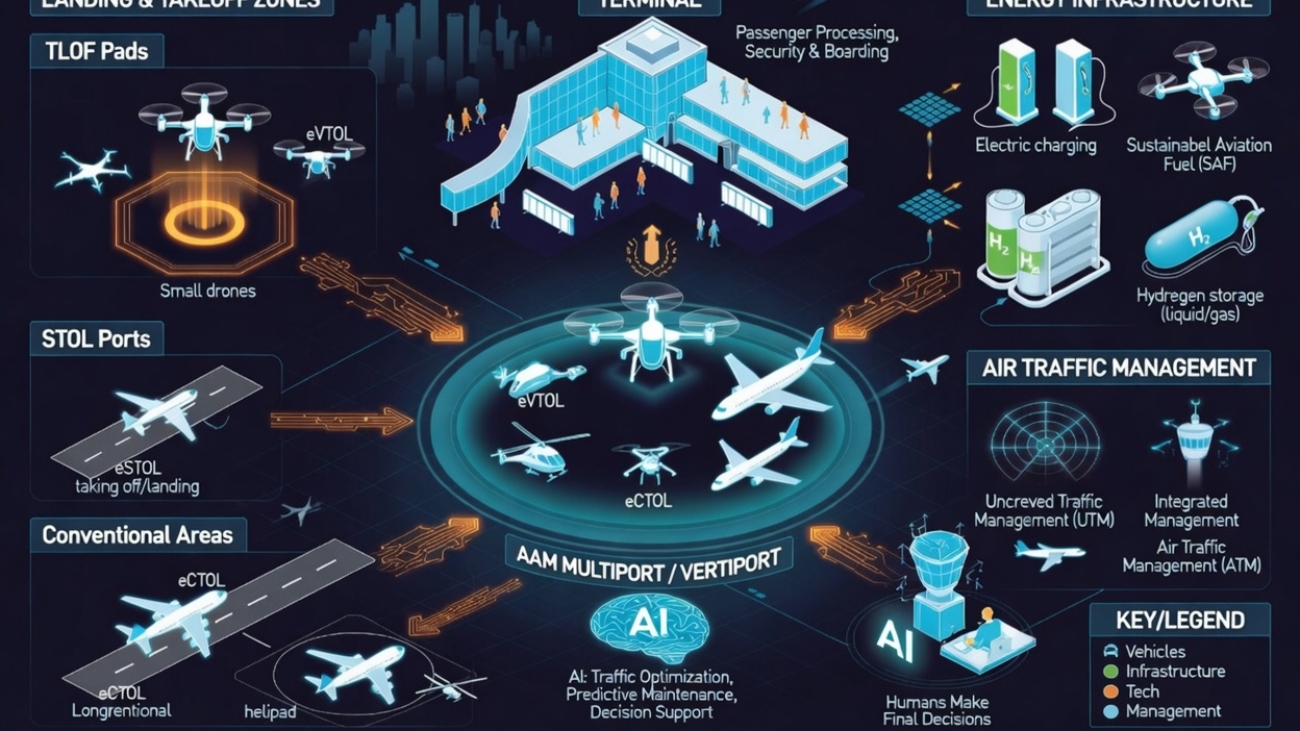
Full vertiport automation is not achievable before 2075 according to leading AI and aviation experts. So what does the right balance between AI and human decision-making actually look like — and what happens to the passenger experience if companies get it wrong?
Holding the Line: Europe’s Clean Aviation Pragmatism in a World Realigning Around Military Spending
The geopolitical shift underway in Washington is real and consequential for Advanced Air Mobility. Federal funding is realigning toward defense and away from clean energy and alternative mobility programs. For a sector that has long relied on the DoD revenue bridge as its near-term survival mechanism, that shift creates opportunity for some OEMs — and accelerates existential pressure for others.
SkyDrive Clears Certification Hurdles & Announces US Strategic Alliance
Japan’s SkyDrive has secured agreement with the JCAB on its General Certification Plan for the SD-05 eVTOL, marking one of the most significant milestones yet on the road to type certification and a planned 2028 commercial launch in Japan and the U.S.
eVTOL & AAM Week in Review — February 27, 2026
Joby books its first Uber passengers. Germany’s ERC System takes Romeo into the sky. EASA rewrites the rulebook for air taxi pilots. And a UK battery startup just hit a milestone that matters for every eVTOL on the drawing board. Your week in electric air mobility, February 27, 2026.
Hawaii is the Ideal AAM Testing Ground
Hawaii is positioning itself for federal eVTOL Integration Pilot Program selection through a partnership combining existing airline operations with electric aircraft technology. Surf Air Mobility, the Hawaii Department of Transportation, and BETA Technologies submitted a joint eIPP application on January 27, leveraging Mokulele Airlines’ position as Hawaii’s largest commuter carrier by scheduled departures. The partnership plans to initially conduct cargo missions between Mokulele’s existing interisland routes using BETA’s ALIA electric aircraft, building on the airline’s 36,000 flights in 2025 averaging 51 miles, ideal for first generation electric aircraft. If selected, the initiative would advance electric aviation through real world regional airline integration rather than theoretical deployment scenarios.
Electric Air Mobility News Site Migration: Quick Heads-Up for Our Readers
This week, ElectricAirMobility.news begins a full site migration to enhance performance and user experience. Expect brief disruptions until completion.
Advanced Air Mobility in 2026: Certification, Corridors and Capital
Advanced air mobility shifts from prototypes to operations in 2026. Joby enters FAA test flights, Archer eyes Miami routes, Eve secures US funding, and vertiports face power constraints.
How Holistic Cybersecurity Should Look in Advanced Air Mobility
Cybersecurity is rapidly becoming one of the most critical challenges for advanced air mobility. In this episode, AJ Khan of Vehiqilla explains why a holistic, ecosystem-wide approach is vital to protect fleets, infrastructure, and passengers in a world where every connection is a potential risk.
FAA’s New Radio Altimeter Rules: What They Mean for Advanced Air Mobility and 5G
The FAA has released a proposed rule that would require most U.S. aircraft to upgrade their radio altimeters to withstand 5G interference. This change will affect not only airlines and business jets, but also future advanced air mobility (AAM) aircraft that rely on precise low‑altitude height data for safe urban operations.
EHang VT35: How China’s New Long‑Range eVTOL Changes the Game
EHang’s VT35 is more than a new airframe; it is the long‑range link that turns today’s EH216‑S urban air taxi routes into a wider, intercity network. With a 200 km design range, compatibility with existing vertiports, and strong backing from Hefei’s low‑altitude economy strategy, the VT35 shows how China plans to scale autonomous passenger eVTOLs from sightseeing flights to everyday regional transport.