

There are more solutions than obstacles. Nicolas Zart.
Electric Aviation Roundup: Five Stories, One Signal
The electric aviation industry has spent the better part of a decade announcing what it will do. This month, five stories arrived in close succession that say something different. Not what the industry plans to build — what it has built, shipped, flown, and certified. The signal is worth naming directly: the transition from announcement cycle to delivery cycle is underway.
Europe Delivers: HECATE Completes a €68 Million Hybrid-Electric Power Architecture
The Clean Aviation HECATE project — Hybrid Electric Regional Aircraft Distribution Technologies — completed in February 2026 with a result that stands out in any funding cycle: on time, on budget, without descoping a single element of its original scope.
That alone is unusual. What the project actually delivered is significant. Thirty-eight partners across eleven countries demonstrated a fully integrated 500 kW electrical architecture at Technology Readiness Level 5, validated on a copper bird test facility at Safran’s site in Niort, France. The architecture operates across three voltage levels — 800V, 540V, and 28V — addressing the power conversion and protection challenges that have made high-voltage aircraft electrical systems one of the harder engineering problems in the transition to hybrid-electric flight.
The project also developed a digital twin of the full architecture. Final validation showed minimal divergence between simulated and real-world results — a level of model fidelity that will be directly useful to the programs that follow.
HECATE recorded a 12% reduction in architecture weight against the 2020-era baseline. The target had been 20%, and the consortium is direct about the gap: what was delivered is a functional proof of concept, not a fully optimized system. The remaining reduction is expected as the technologies are refined in Clean Aviation Phase 2, against a more specific aircraft architecture.

The total budget was €68 million, including a €34 million European Union contribution and €6 million from UK Research and Innovation. A flight test demonstration is targeted by 2030.
VerdeGo Ships: From R&D to OEM Customer Deliveries
VerdeGo Aero has crossed the threshold that separates development programs from market participants: it is shipping its VH-4T-RD hybrid-electric powerplant to customers for testing.
The deliveries are pre-certification. What VerdeGo is offering OEMs is the ability to put actual hardware through their development and test programs before the certification process concludes — compressing the integration timeline on the customer side and generating real-world data that will feed the certification path. For aircraft manufacturers evaluating hybrid-electric propulsion options, this changes the evaluation from a paper study to a hardware program.
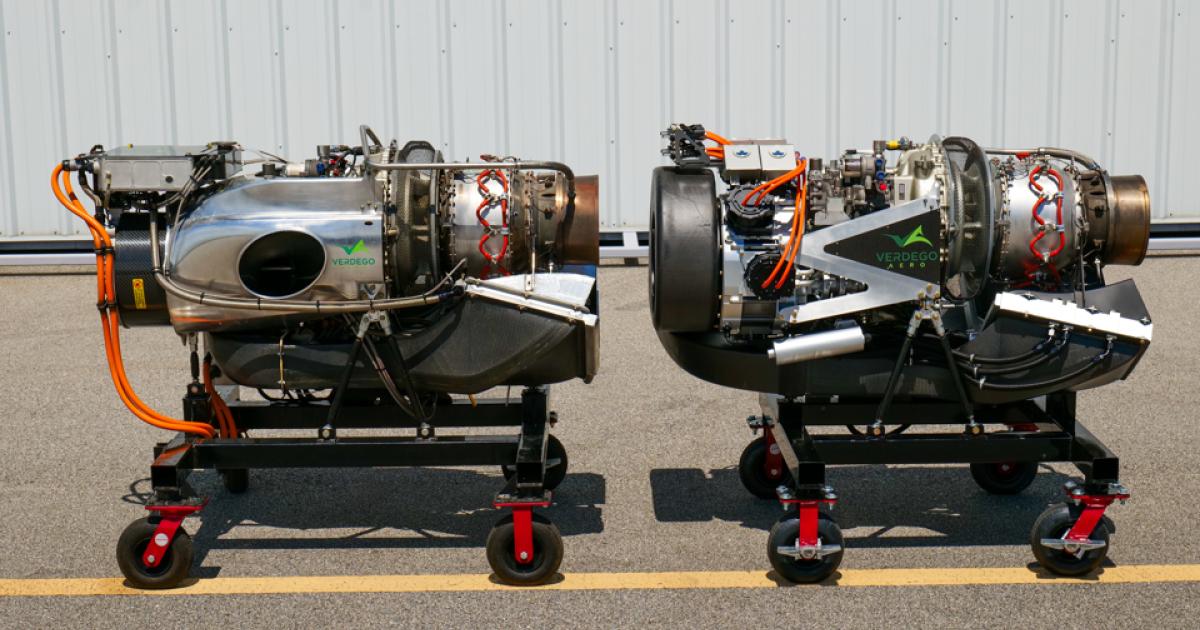
VerdeGo has been one of the more methodical companies in the hybrid-electric propulsion space, building toward deliveries rather than demonstrations. This step confirms that trajectory.
CycloTech’s BlackBird Flies: 360-Degree Thrust in the Real World
Austrian startup CycloTech has achieved vertical takeoff with its BlackBird demonstrator — a 4.9-meter long, 2.3-meter wide aircraft powered by six cyclorotors.
The cyclorotor is a fundamentally different propulsion approach from the fixed-axis rotors used in most current eVTOL designs. It generates thrust in any direction through 360 degrees, which allows the aircraft to brake in flight, hover at an angle, and maneuver in confined spaces with a precision that conventional multi-rotor configurations cannot match. CycloTech describes the capability as the ability to “park” the aircraft with high positional accuracy — a characteristic with direct implications for operations in dense urban environments and at small-footprint vertiport facilities.

The first vertical takeoff has been completed. What happens next in the certification and development process will determine how this propulsion approach fits into the broader market, but the technical foundation has been demonstrated in flight.
Airspeeder Mk4: Certification, AI, and the Proving Ground Argument
Airspeeder unveiled its next-generation Mk4 racing eVTOL at The Bend Motorsport Park in South Australia, alongside the launch of the Airspeeder International Series — a ten-nation competition structure built on the premise that competitive racing is the most rigorous proving ground for advanced flight systems.
The Mk4 received world-first experimental certification from Australia’s Civil Aviation Safety Authority before the event. At its core is AI Forcefield — Airspeeder’s proprietary shared-control system enabling close-proximity racing through real-time collision avoidance and intelligent flight control. The platform was featured in NVIDIA CEO Jensen Huang’s keynote at GTC, positioned as a leading example of physical AI systems operating in the real world.
The event marked the competitive debut of Team Australia and Team Italia, both flying the Mk3C platform. Partners include Intel, Dell, AWS, Telstra, and IWC Schaffhausen.
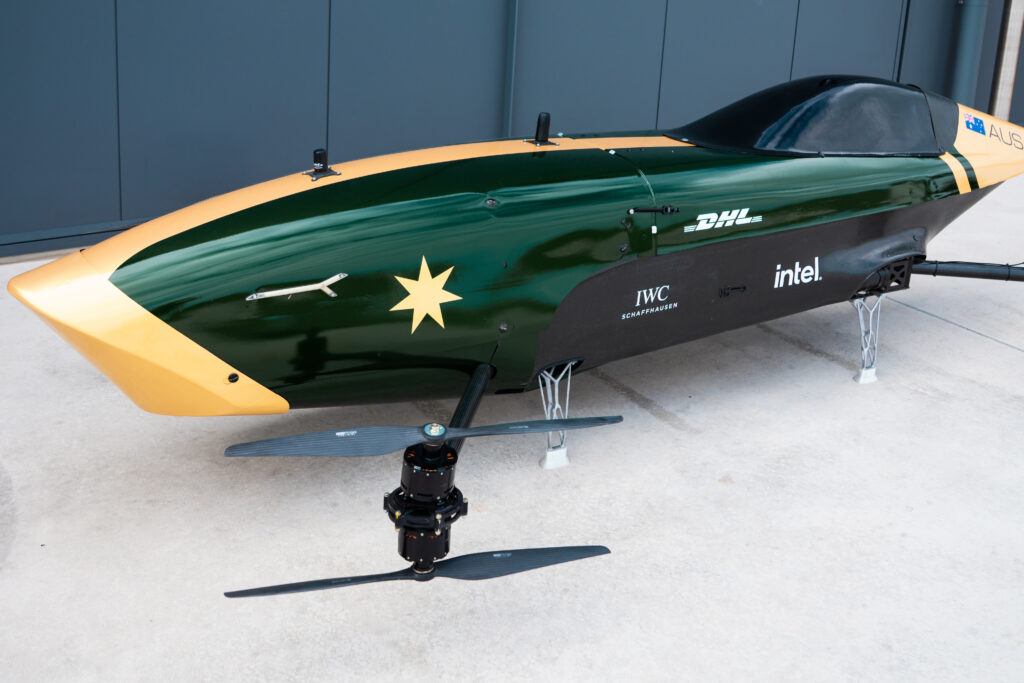
The Formula 1 parallel is deliberate. Racing accelerated automotive development for a century by forcing solutions to problems under conditions no simulation can fully replicate. Whether that model transfers cleanly to eVTOL development is worth watching closely. The certification record, the AI systems, and the global partnership infrastructure suggest Airspeeder is making a serious case for it.
Volocopter VoloXPro: The Training Platform the Industry Actually Needs
Volocopter unveiled the VoloXPro at AERO Friedrichshafen — a fully electric ultralight multicopter designed for flight training, air sports, and professional passenger transport. Built on proven VoloCity components with fly-by-wire controls and a modular platform concept, it is targeting ultralight certification in Germany by end of 2026, with parallel approvals across Europe to follow.
Volocopter describes it as the first aircraft in Germany’s ultralight category to deliver commercial aviation-level safety standards.
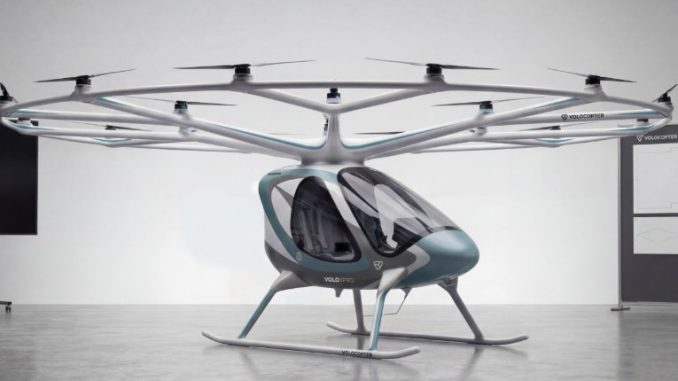
The workforce context matters here. The vertical lift industry is facing a 10-year cliff. The average helicopter mechanic today is 56 years old. Pilots trained to operate the next generation of vertical lift aircraft need to start training before the aircraft that will employ them reach commercial service. A certified, cost-effective electric training platform that prepares pilots specifically for eVTOL operations is not a peripheral product. It is infrastructure — and it connects directly to the workforce development priorities that organizations like VAI are pushing as a strategic imperative.
The Single Signal
Five different companies. Five different propulsion and platform approaches. Five different market segments. What connects them is that each crossed a material threshold this month — not an announcement, not a rendering, not a projected delivery date. A completed architecture. Shipped hardware. A first flight. A certification. A product ready for commercial training operations.
The industry has spent years asking when proof of concept becomes proof of production. The answer is starting to come in.