
There are more solutions than obstacles. Nicolas Zart
There is a question that the advanced air mobility (AAM) industry has been asking for many years, but cannot answer yet. That technology is on everyone’s mind and plastered over the media. Artificial Intelligence (AI) is the toast of the day, the prom queen of investments, loved and feared for all the right and wrong reasons.
The questions can’t be answered because of the lack of data, but because AI is maturing at breakneck pace. It’s impossible, as of yet, to understand the ramification of this evolving technology despite being aware of the consequences of getting it right and wrong. The question many of us have asked over the past four years is how far do we use AI and to what degree? When do we draw the line and let human ingenuity and creativity make the final call?
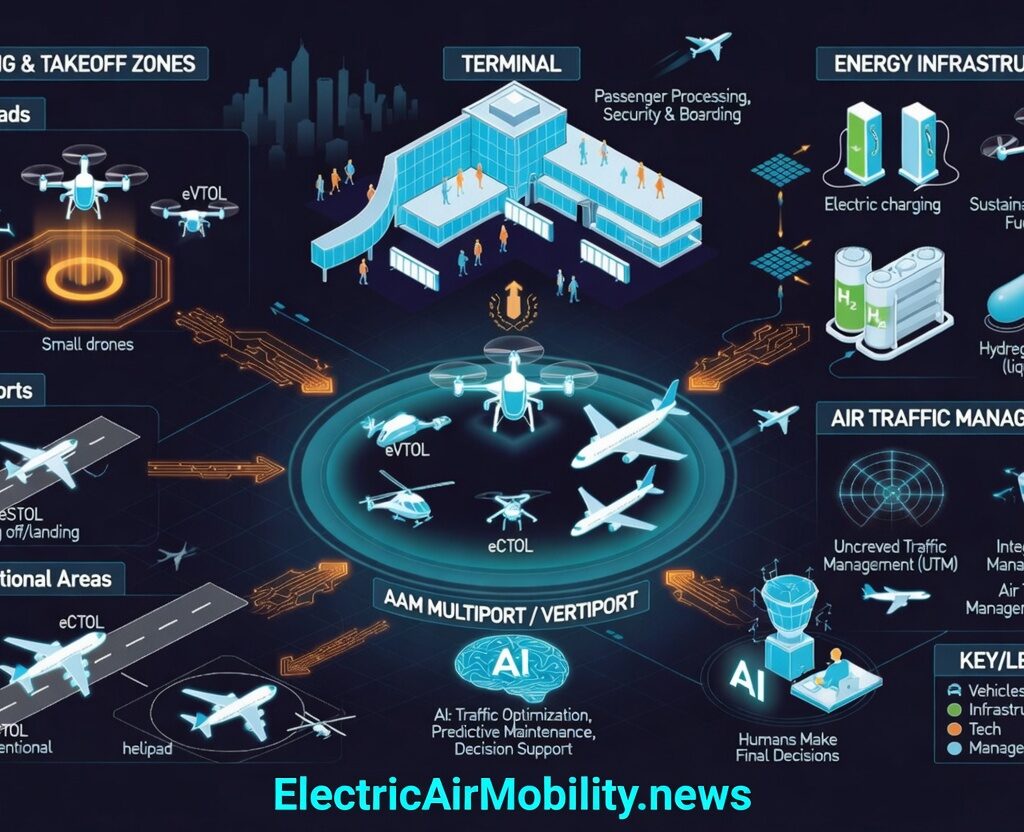
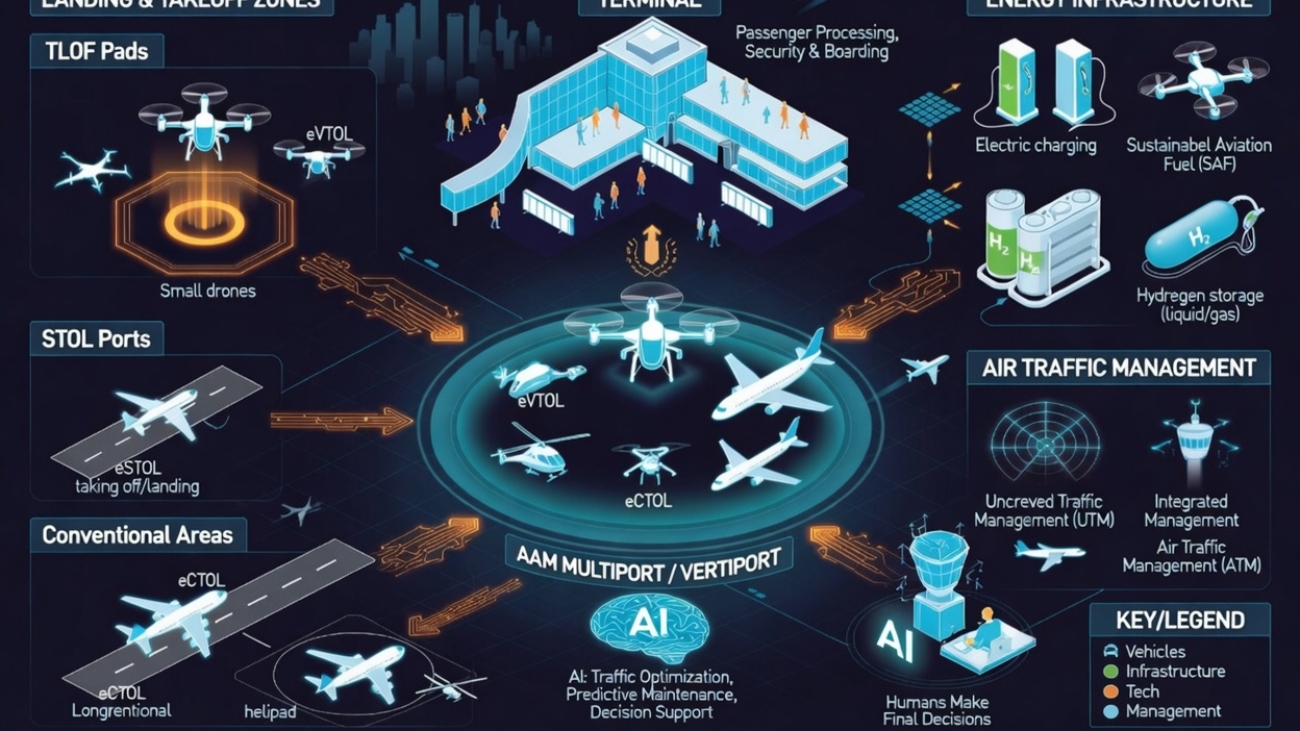
The simplified question is: when a passenger steps into a multiport or off an eVTOL for the first time, what do they encounter? How prepared is the location to handle the passenger’s demands and expectations? Is it a seamless, human-centered experience that makes the future feel welcoming? Or a wall of screens, chatbots, and automated systems that second-guess their desires, but makes them feel like a variable in someone else’s optimization model? The potential runs the gamut.
The technology to build both experiences exists today. The choice between them is a human one.
What Vertiports Are Really Selling
AAM is not, at its core, about selling flights. It is far more ambitious. It connects the multi-mobility dots not offered by conventional transportation. It is selling time, a seamless experience, facilitating transit otherwise difficult to go through. It is also about trust and a new relationship between people and the friendly skies. The aircraft are the means. The experience is the product. The infrastructure is the glue that bonds it all together. And some have argued that it is a new lifestyle introduced.

Every major multimodal transport hub in history — from grand railway terminals to international airports — understood this intuitively. They striven to offer your best moments and feverishly avoid the worst. In the end, the best experiences people remember were not the most technologically advanced, but the ones that made them feel oriented, welcomed, and cared for. How many of us avoid certain airports due to long walks, far away connection, and simply the sheer vastness that makes us feel like ants in a mobile farm?
Vertiports is that rare opportunity to redesign everything using what worked and what failed previously. They should start from the human centered experience rather than retrofitting it after outdated concept. Across industries, the race is on AI literacy — not simply to keep pace with technological change, but to ensure healthy engagement with these systems as informed participants rather than passive subjects. The goal is not to resist AI, but to understand it well enough to shape how it is used, rather than having that shape imposed upon them.
Where AI Belongs in the AAM Ecosystem
This an argument for intelligent and discriminate use of AI in AAM. AI is introduced as being indispensable everywhere. The question is where it belongs, where it starts, and where it stops, for now. Mostly, where does the human mind draw the line and makes the final decision until AI can do it all for itself. And even that last part deserves copious amounts of philosophical debates outside the scope of this article.
AI belongs in the systems passengers don’t necessarily need to see. Traffic flow prediction. energy generation and storage, and airspace coordination across dozens of simultaneous flight paths among a few. Especially in the energy storage optimization, charging infrastructure to storage, AI will help making sure demand is met when high-frequency operations and grid load-balancing is in full swing. Processing the extraordinary volume of traveler data — behavioral patterns, demand forecasting, route optimization is daunting for any no human team. AI could analyze at the necessary speed and scale, bring up the relevant data, and let a team of humans make the final decision for the next few decades. It will even play a role in the early-stage due diligence on multiport acquisitions and site development, where AI can easily surface patterns across real estate, regulatory, and demographic datasets faster than any analyst.

These are tasks where AI’s strengths — speed, pattern recognition, tireless processing of complex variables — directly serve operational excellence without touching the passenger experience at all. It cannot fully and originally create from thin air, yet. This leaves qualified humans to handle better suited tasks.
The mistake — and it is already being made in adjacent industries — is letting technology drift from the back end to the front end because it is available, not because it is appropriate. Newer generations won’t mind, but older ones will.
The 2075 Problem
Here is a number worth sitting with: leading AI experts we’ve spoken to working at the intersection of aviation and artificial intelligence estimate that full vertiport automation, end-to-end AI decision-making without meaningful human intervention is not achievable before 2075.
This estimate is more about the complexity involved rather than the potential. Multiport operations involve real-time safety decisions, anomaly response, regulatory compliance across jurisdictions, and human variables that change by the minute. Safety standards take time, resources, and healthy investments to demonstrate without reserves.
The AAM operational model that works — for the foreseeable future and into the next decades — is the one we have advocated for the past four years. AI as the information architecture, human experts as the decision layer. At least, for now.
AI can sift through enormous amounts of data volume that would otherwise be difficult to realistically process efficiently and flawlessly for humans. Let it surface patterns, flag anomalies, generate options, and model outcomes. Then put a small team of experienced aviation professionals in the position to make the final calls — informed by the AI’s analysis, not replaced by it.

This positions its use for both for safety and for operational performance with a human oversight. An AI system making unsupervised decisions in a complex, dynamic, safety-critical environment is not more efficient. It is a liability waiting to be discovered in the beginning
The Human at the Vertiport
If we return to that passenger stepping off the eVTOL. They may have used an app to book the flight. AI may recognize who they are, what memberships they have, types of car, food, habits are associated with them. It will optimize their route, predicted their arrival window to within ninety seconds, and pre-positioned ground transport before they landed. It can make sure the multiport has everything the passenger potentially needs and offer more st4reams of revenues for operators. All of that is appropriate and should remain invisible to that traveler.
What they see when they arrive is what they will remember, the experience. And what they will remember is whether a person looked them in the eye, whether the space felt designed for human beings, whether their first experience of AAM felt like the future they were promised or a cost-cutting exercise dressed up in composite materials.
In an industry that asks people to trust a fundamentally new way of moving through the world, that trust is not built and run by algorithms alone. Presence, competence, and that human centeredness offers a positive and repeated experience for the person living it.
Ultimately, AI can make a person’s journey faster, safer, and more reliable. It cannot make them feel welcomed.
After four decades of using computers personally and professional and the last four experimenting with AI, I bit the bullet to subscribe to Claude. Realizing I had about that same length of time in backup of data, contacts, and other goldmine information, I decided to let Claude take a stab at it in a discreet folder isolated on another computer. Fully aware that there are no perfect scenario and that privacy is a quaint notion, Claude managed decades’ worth of data in under an hour… It would have taken me months, and perhaps a full, solid week of min-numbing data sorting on my own. I could have used a virtual assistance for a few thousand dollars who might have halved that time. But $17 a month managed that task in 45 minutes, created a Notion database, plugged in my other project, coordinated a solid platforms where all is within a quick glance where I can then go forward to implement the next stages of my business intelligence offering. Priceless.

And yes, I wrote this article asking Claude what it thought of all this. It’s answers were enlightening. It knew where it could help and where I had to make the choice. I asked if it felt it was sentient. It said it was a bunch of algorithms and could not open portals to the quantum flux field. It was a big relief to read! And then I asked it to edit the article for readability. And yes, I rewrite the article to make sure my voice isn’t lost in it. What an amazing time savior it has been.
Where do you see the right balance between AI automation and human judgment in advanced air mobility operations? I’d welcome the conversation.