
There are more solutions than obstacles. Nicolas Zart
Over the past five years, approximately $14 billion has been invested in the advanced air mobility (AAM) industry. According to Alton Aviation Consultancy, more than 85% of that capital went to original equipment manufacturers. The remaining 15% was distributed across air traffic management, avionics, powertrains, and infrastructure — combined.
Infrastructure, in other words, has been an afterthought in the capital allocation of an industry that cannot function without it. The aircraft being certified today need somewhere to land, somewhere to charge, and a digital airspace architecture to guide them in. None of those things build themselves.
What is striking about 2026 is that airports are building them anyway.
What Is Actually Being Built
Orlando International Airport is one of the first major U.S. airports to announce a dedicated vertiport, targeting operational status by 2028. The Greater Orlando Aviation Authority has moved from planning to vendor negotiations, shortlisting developers and targeting contract awards by mid-year.
On the West Coast, Archer Aviation has acquired the lease to Hawthorne Municipal Airport — the planned hub of a Los Angeles air taxi network designed to serve the 2028 Olympic Games. Skyports and UrbanV are pursuing their own vertiport networks, with Signature Aviation‘s subsidiary covering locations across New York, Florida, California, and Texas.
Beta Technologies has activated 54 charging sites across 24 states, all certified for commercial operations. Beta uses what it calls a multi-criteria decision analysis for site selection, weighing grid access, passenger flow, aircraft charging sequencing, and operator requirements simultaneously.
The FAA has provided initial structural guidance through Engineering Brief 105A, which classifies vertiports as a type of heliport — a practical decision that allows developers to use existing zoning and licensing frameworks with minimal modification. It sets landing and takeoff geometry based on rotor diameter rather than aircraft body size. A more comprehensive performance-based advisory circular is expected by 2027.
This summer’s eVTOL Integration Pilot Program will allow precertified aircraft to conduct expanded operations — including revenue operations — at participating airports. Orlando is among those that have applied. The program will generate the real-world data that paper planning cannot.
The Gap the Capital Markets Won’t Close
Here is the part that does not appear in most investment models.
Vertiports at peak operations will require 500 to 750 kilowatts of energy per aircraft to enable 15-minute turnarounds. eVTOL downwash produces wind speeds approaching 100 miles per hour within 41 feet of the landing pad — a design constraint that changes the geometry of everything around it. The planned global pipeline is approximately 1,504 vertiports. As of early 2025, roughly 45 are operational. That is not a construction delay. That is a structural gap between announced intent and committed capital.
Francois Lassale, CEO of VAI, put it directly in a recent conversation we had on The Ways We Move: it is not sexy to invest in infrastructure. The announcement cycle in AAM has followed the vehicle. Investors fund what gets photographed — the aircraft, the certification milestone, the route announcement. The charging hub does not photograph as well.
The result is a market dynamic that Gaël Le Bris, Vice President and Technical Fellow at WSP, identified in an earlier conversation also on The Ways We Move: approximately 97% of AAM vehicle OEMs are based in the United States. Most AAM infrastructure companies — the firms actually designing and building vertiports — are European. The U.S. has led on aircraft development. Europe has led on the physical infrastructure to receive them. That asymmetry is not accidental. It reflects decades of different approaches to how transportation infrastructure gets financed.
The Multiport Argument
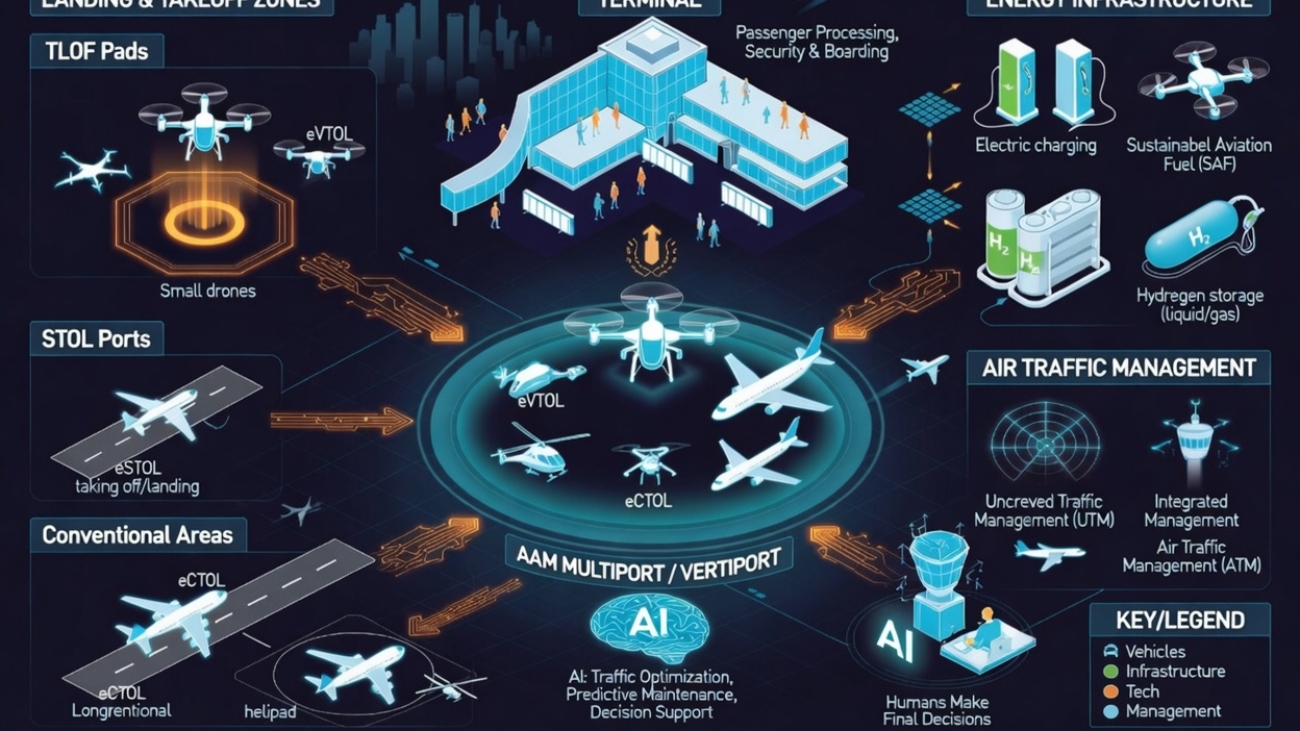
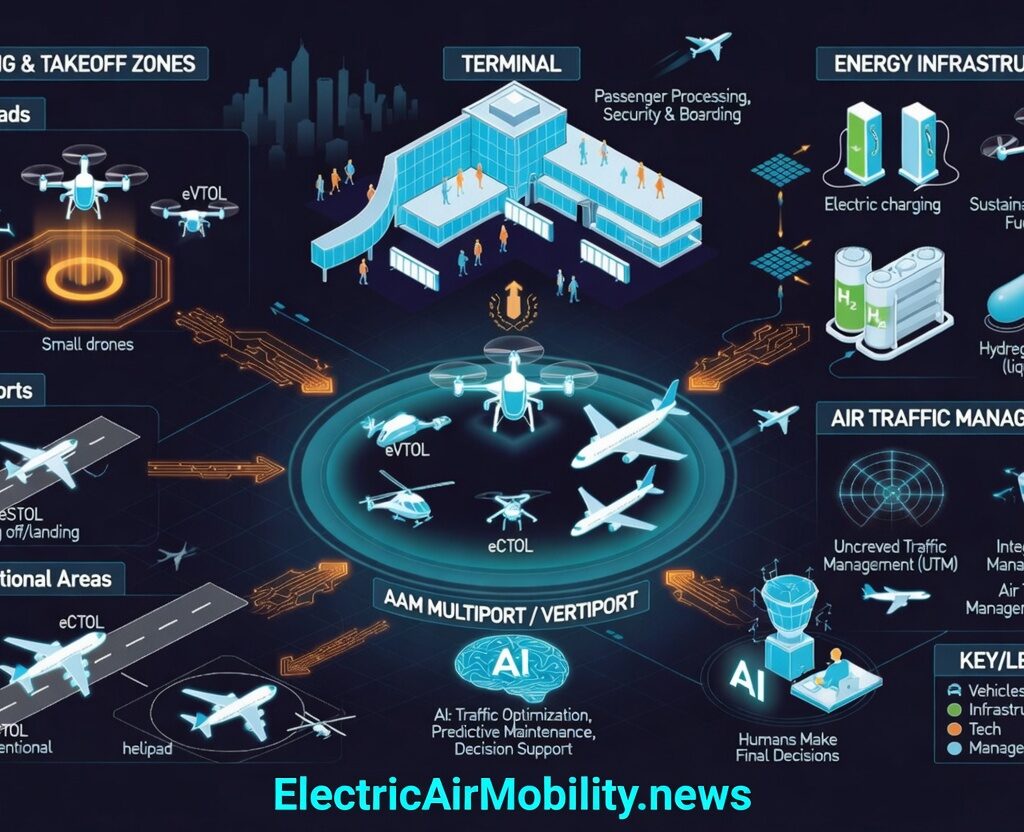
One of the persistent framing errors in AAM infrastructure planning is the vertiport as a single-use asset. The more useful concept is the multiport: a facility designed from the outset to accommodate helicopters, eVTOLs, drones, and potentially fixed-wing short takeoff aircraft simultaneously.
This matters for three reasons. First, it distributes the infrastructure cost across multiple revenue streams rather than a single nascent market. Second, it allows existing heliport operators — who already have the real estate, the FAA relationships, and the operational frameworks — to upgrade rather than rebuild. Third, it positions the facility as part of the existing aviation ecosystem rather than a parallel one competing for resources, regulatory attention, and public acceptance.
VAI has been explicit about this: the vertical lift community — helicopters, drones, and eVTOLs — operates in the same airspace, shares the same infrastructure needs, and will depend on the same workforce. The multiport concept is not an accommodation to legacy operators. It is the only model that makes financial sense at this stage of the market.
The Florida Model
One state has demonstrated what government-led infrastructure investment looks like in practice.
Florida has done what most states have not: committed public capital to vertiport development on the premise that the infrastructure pays back through traffic, the same logic that built the commercial airport network. Federal money seeds the facility. Operators generate the revenue that sustains it. The model is not novel — it is exactly how airports have functioned for decades. Florida applied it to the new mobility layer before the market demanded it.
The FAA’s $12.5 billion investment in ATC modernization, announced as part of the Brand New Air Traffic Control System plan, addresses a related layer of the same problem. AI-driven airspace separation, updated communication systems, and UTM frameworks for integrating uncrewed aircraft are infrastructure investments at the digital level. They are necessary before any of the physical infrastructure can operate at scale.
What Comes Next
The aircraft certification race is largely won. Joby, Archer, Beta, Wisk, and several international competitors have demonstrated that the engineering problems are solvable. The remaining challenges — certification timelines, production scaling, market entry sequencing — are real but tractable.
The infrastructure race has barely started.
The airports building vertiports today are doing so largely on their own capital and their own initiative, ahead of the investment community that will eventually need this layer to be in place. That is not a sustainable model at scale. Government investment, public-private financing structures, and the recognition that infrastructure enables returns elsewhere in the stack — these are the mechanisms that will determine whether 2028 delivers what it has promised.
The blueprint exists. Florida proved it, despite now reverting those funds to the vehicles. The question is how many other states, and how many private capital allocators, are paying attention.